


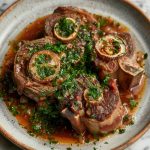
Beef Shanks Osso Buco Recipe
Beef osso buco is a classic Italian braise in which meaty beef shanks are seared, then slowly simmered with wine, aromatics, tomatoes, and stock until fork-tender, then finished with bright gremolata for balance.
Servings: 6 servings
Equipment
- heavy-bottomed Dutch oven
Ingredients
For the Braised Shanks
- 6 beef shanks about 1½ - 2 inches thick
- salt & pepper to taste
- ⅓ cup all-purpose flour
- 3 tablespoons olive oil or butter
- 1 large onion finely chopped
- 2 carrots finely chopped
- 2 celery stalks finely chopped
- 4 cloves garlic minced
- 1 cup dry white wine or red if preferred
- 2 cups beef stock
- 1 14 ounce can dice tomatoes
- bouquet garni optional
For the Gremolata
- ½ cup fresh parsley finely chopped
- zest from 1 lemon
- 2 cloves garlic minced
Instructions
Prep the Meat
- Pat beef shanks dry with paper towels. Season generously with salt and pepper.
- Lightly dredge each shank in flour, shaking off excess — this helps build color and flavour.Tip: Cutting a couple of small slits in the outer membrane prevents the shanks from curling during searing.
Brown the Shanks
- Heat olive oil and/or butter in a heavy-bottomed Dutch oven over medium-high heat.
- Sear the shanks in batches, without crowding the pot, until deeply browned on all sides — about 3–4 minutes per side.
- Transfer browned shanks to a plate.Tip: Browning isn’t just about color — it creates those rich fond bits that amplify the braising liquid.
Build the Braise Base
- Reduce the heat to medium. Add onions, carrots, and celery to the pot. Sauté until softened and starting to caramelize (about 6–8 minutes).
- Stir in garlic and cook until fragrant, about 30 seconds.
- Pour in the wine and scrape up browned bits from the bottom. Cook until the wine has mostly evaporated.
Add Liquids & Shanks
- Return the shanks to the pot, placing them standing up if possible.
- Add beef stock and diced tomatoes, then nestle the bouquet garni among the shanks.
- Bring to a gentle simmer.Tip: Keep the heat low — a rolling boil can tighten fibres and make meat tough.
Braise Low & Slow
- Cover the pot and transfer to a 325°F (163°C) oven or keep on the stovetop at very low heat.
- Cook for 2–3 hours until the meat is fork-tender and nearly falling off the bone.
- Check every 45–60 minutes — if liquid gets low, add a splash of stock.Tip: The magic of Osso Buco is patience — slow heat transforms collagen into glossy gelatin.
Make the Gremolata
- While the shanks finish cooking:
- Combine parsley, lemon zest, and minced garlic.
- Sprinkle over the finished Osso Buco just before serving.Tip: Gremolata cuts through richness with brightness — don’t skip it!
Serving & Finishing
- Sauce: If the braising liquid is too thin, remove the shanks and simmer the sauce uncovered until it lightly coats a spoon.
- Rest: Let the dish sit off heat for 10 minutes before plating — juices redistribute for a juicier bite.
- Sides: Serve with risotto alla Milanese, creamy polenta, or mashed potatoes to soak up the sauce.
- Leftovers: Flavors deepen overnight — Osso Buco is excellent reheated the next day.
Notes
I have a large five quart French Oven by Le Creuset that I use for most of my braising recipes. it is one of my favorite pieces of cookware. Yes, Le Creuset is expensive but it is the type of pan I will have for the rest of my life and will probably be in one of my kids lives for a generation or two.
This is an incredibly doable recipe for any home cook with just a little experience and the results are fantastic. I do recommend using veal shanks but if you do not eat veal, give the beef shanks a try but try cooking them a bit longer and see if that makes a difference.
If any of you have had a different experience with beef shanks or have suggestions on making them more tender, please let me know.


Osso Buco Leftovers
Ingredients
- osso buco leftovers
- 1 pound pappardelle pasta or egg noodles
- salt to taste
- side dishes your choice
Instructions
- I started by heating up a big pot of water to cook the pasta. (see my pasta tips)
- Then I took all the meat off the center bone, cutting it up into ½ inch chunks. Another option might be to shred the meat with your fingers.
- Once the meat is cut or shredded, add it to a saucepan that will hold the meat and the leftover sauce. Heat that up over low-medium heat.
- While the meat is reheating, add some salt to the pot of water and then add the pasta. Cook the pasta to a firmness you like. I find the pappardelle pasta or any egg noodle pasta because it cooks faster than spaghetti or penne. So, be sure to time your side dishes accordingly. You want to serve this as soon as the pasta is cooked to your perfection.
- When the pasta is done, drain it, plate some in a large soup bowl so you can add a lot of that wonderful sauce and serve.
- I served these leftovers with a fresh salad with a mustard vinaigrette along with some broccoli that I made for the kids. It really doesn't get much better than this.


16 Responses
This looks like a good recipe. I’ll try it. I’ve had pretty good luck with Osso Bucco with both veal and beef shanks. Veal is much better. Thanks for the the tip on tying them. I don’t know why I never thought of that. DUH….;) I have never tried basting the shanks. If I use Le Creuset I place a large sheet of heavy duty tin foil over the top. I punch it down to make it concave. I seal it tight and put on the lid. When the braising liquid condenses it drips down over the meat instead of down the sides of the French oven. Much less expensive is the “old Fasioned” cast iron Dutch oven. On some of the lids (I don’t know which brands..maybe Lodge.) the under side has been cast with “cones” projecting down to the meat. This causes constant basting. I haven’t tried the Dutch oven for Osso Bucco. I don’t know if it’s too much basting. I’ve used it for tougher cuts; ie, chuck roasts and they turned out good. I guess it’s a matter of experimentation. Anyway, thanks for your great web site.
P.S. He used the beef shanks and it worked just fine!
My husband had a hankering for Osso Buco – even though he didn’t know what it was. He was reading a poem titled “Osso Buco” by Billy Collins and decided that he would make it for me. We found this recipe and it was so well written that my husband who has NO COOKING experience found it easy to make. It was extremely tasty. He did not alter a thing. Excellent! Thank you! It was nice to have him cook for me for once 🙂 !
i use beef shanks alot as they are easy to get and very economical here in Argentina and have never had the problem of them being dry or not falling off the bone.. i braise them until they fall off the bone and the timing varies on the beef. I agree veal is better, but if you are patient this can be very good as well
I’ve used both beef and veal shanks.
I much prefer the veal. Much more tender and do not seem to get tough from prolonged cooking. I braise in a 250 degrees F oven for at least 2 1/2 to 3 hours. Be sure to have enough braising liquid.
Hi Michael, I agree I prefer veal over beef shanks but the beef is a great economical substitute. – RG
Thanks big time amigo, wife only likes lamb as french cut chops, yet I love Osso bucco. Tried the recipe with two lamb and a beef, yes all in one pot!. All were happy! You da man!!!
Hey Randal, glad it worked out – RG
I had Osso Buco alla Fiorentina in Florence less than a month ago, and it was made with beef. It was tender and tasty. Unless I missed something (too long a commentary), I see a few reasons for the beef not being so tender as you wanted it to:
1. For four shanks you used half the amount of wine and you reduced it to almost nothing, thus taking away the acidity that would act as a tenderizer.
2. You may not have had enough liquid. The stock, wine, water, and tomatoes should be almost even with the top of the shank.
3. You did not keep it in the oven long enough. I would bake it for at least 2 1/2 to 3 hours — longer if necessary, as well add more liquid if too much has evaporated. Don’t be tied to a timer.
Personally, I prefer beef over veal. To me veal, although somewhat more tender, has a weaker taste. Unless you are a lover of anchovies, they are a “no-no”. Osso buco recipes do not call for anchovies, but I do concede that it is a matter of personal taste.
Hi Anthony and thank you for your comments. I would be very interested in checking out your recipe for this dish and give it a try. Sounds like you have one that works better than mine. I was trying to use my veal osso bucco recipe from Cuisine Magazine and it may not have substituted very well.
I agree I may not have cooked it long enough but I don’t agree the liquid should be “even with the top of the shank.” I want to braise not stew the meat. As for anchovies, I agree, it is a matter of personal taste and I have seen many osso bucco recipes with and without. Some even have the anchovies in the gremolata served with the shanks.
So please send me your recipe via email and where it is from and I will give it a try. – RG
Posts like this brighten up my day. Thanks for taking the time.
Sorry to correct your pronunciation but…do not say aw-soh unless you are British. In Italian an O is always ‘oh’ so it is oh-so boo-koh. ; )
This recipe is brilliant! I learned to cook ossobucco when I was living in Firenze from Medici Cooking School. It is one of my favorite dishes but, I lost my text book and cannot remember the recipe. I have battled to find a recipe that used anchovies because that is the way we learned it there. I went the beef route and took the advice of Mr Murdocca as I prefer it a bit stewy.
I used beef shin bone which is a thinner cut, therefore I actually snipped the outer rind a few times to prevent the meat fom curling up as it browned. I tossed the meat in flour mixed with seasoning. I used half a bottle of red wine and 500 ml of stock. Cooking time came to 3.5 hours and temperature ranging between 150 and 170 centigrade. The meat was deliciously tender and the bones were clean as I picked them out.
Thank you RG for sharing this, I really enjoyed making it and it was scummy! Will definitely make again.
I live in Ecuador and veal shanks are not readily available here. Pork and beef shanks are, and I tried this recipe with both types of meat. I prefer the pork here, because it seems more tender, but prefer the flavor of the beef. Either way, it’s the sauce and the marrow that matter most! Your recipe had all the right ingredients for a succulent dining experience. Thank you for sharing.
Christa
I would like to try the beef & pork together. Maybe even mushrooms added to your recipe for the osso-buco revisited.
Any suggestions? I LOVE the combo of beef roast & pork roast with onion chopped fine, Bet the osso-buco- would be awesome like that..
Sauce great, beef shanks, hard as rocks. I even put them in the slow cooker for 7 hours. I had some wagyu grass fed beef shanks and did everything I usually do but these suckers needed a good knife to get thru them. I have had more tender chuck roast. Thoughts?
Sean, I’m not sure how any meat cooked for 7 hours can be tough. They might dry out but tough? I just read a post on SeriousEats that is a little technical called Stew Science: Why You Shouldn’t Cook Your Beef All Day that may answer your question.
Under the heading:
Beef Osso Buco At A Glance (above the recipe and instructions)
Why this version works
Beef shanks bring deeper flavor than veal. Slow heat transforms connective tissue into silk. The result feels hearty, comforting, and intentional.
Just below the instructions under the heading:
How to make at home;
After two hours with veal shanks, the meat falls off the bone. With the beef shanks, this wasn’t the case. The meat was not as tender as I would like it to be. I’m still not sure if it’s the meat or if I need to cook them longer. In any case, and my opinion, the veal shanks are generally more tender and have more flavor.
? ? ? ? ? . . . . . ?
Jon, yes, I can see why you thought this recipe was confusing, so I completely redid it with better step-by-step instructions. I hope this helps.