


Ever feel like dinner night turns into chaos in the kitchen? That’s exactly what mise en place is designed to fix. This simple setup technique gets your ingredients prepped, organized, and ready before the heat hits the pan—so you cook with confidence instead of scrambling. Learn how pro chefs use it to make every recipe smoother and more delicious.
Why Mise En Place Matters
- Stay Organized: Prep ingredients in advance to avoid mid-recipe scrambling.
- Cook Smarter: A clear workflow saves time and reduces stress.
- Better Results: Consistent prep leads to consistent flavors and textures.
- Kitchen Zen: A clean, organized space makes cooking more enjoyable.
- Boost Efficiency: Use a simple mise en place checklist to streamline every meal.
Why Mise en Place Will Change the Way You Cook (Simple Steps)
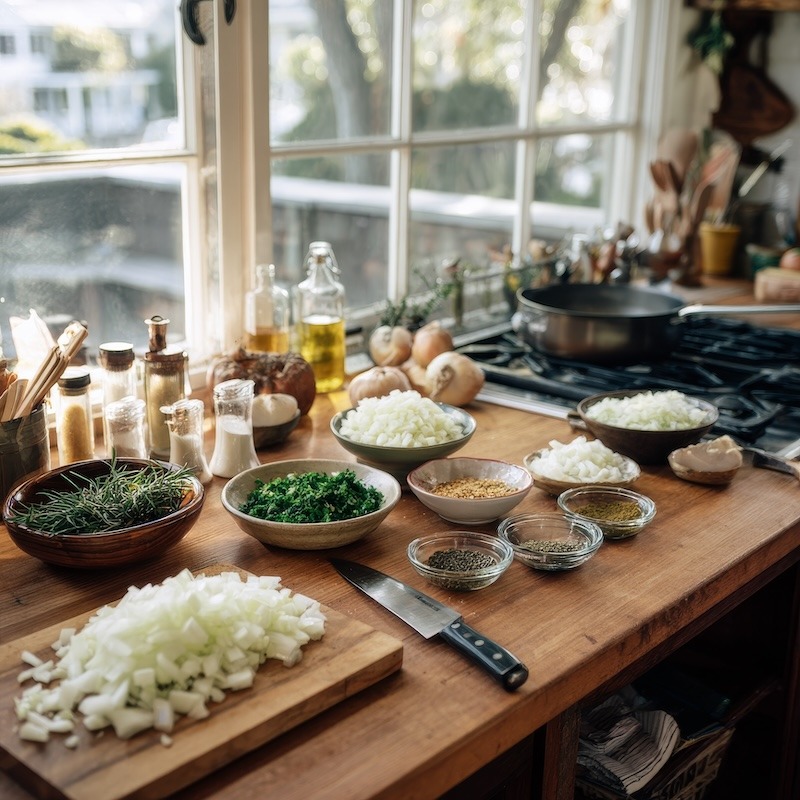
Even in a small home kitchen, taking a few minutes to set up your ingredients and tools pays off big. A clear mise en place checklist ensures you won’t be scrambling mid-recipe, helping you stay calm and focused. This cooking prep technique isn’t just about organization — it’s about working smarter, not harder, so you can enjoy the process as much as the final dish.
Simple Home Cooking Tips for Every Meal
Start by reading your recipe from start to finish, then prep all ingredients and tools before turning on the stove. These kitchen organization tips keep your counters clear, your timing on point, and your stress level low. With these small steps, you’ll find yourself cooking faster and easier — even with complex recipes — and consistently achieving better results.
Turn Prep into a Habit
Think of mise en place as a ritual, not a chore. A few minutes of prep now can save you a lot of frustration later. By mastering this cooking prep technique and following your mise en place checklist, you’ll develop habits that make home cooking enjoyable, efficient, and predictable. Over time, these home cooking tips become second nature, turning any meal into a smooth, stress-free experience.
Examples of Mis En Place
| Prep Step | Why It’s Important | Problems If Skipped |
|---|---|---|
| Chopping all vegetables before stir-frying | Ensures quick, even cooking | Overcooked or unevenly cooked vegetables while prepping on the fly |
| Bringing butter to room temperature before baking | Ensures proper texture | Dense, flat baked goods caused by cold butter |
| Cracking eggs into a bowl before adding to batter | Prevents shell fragments and mistakes | Shell bits in the mix or accidentally using a bad egg |
| Measuring spices before starting curry | Guarantees balanced flavors | Forgetting a spice or adding too much or too little |
| Organizing all tools before cooking | Streamlines workflow | Wasting time searching for utensils while food burns or dries out |
| Portioning pasta and prepping sauce ingredients | Keeps timing on track | Overcooked pasta while scrambling to finish the sauce |
| Pre-measuring broth or liquids for risotto | Maintains consistent cooking | Running out of liquid or adding too much too late, affecting texture |
| Prepping and marinating meat before grilling | Enhances flavor and texture | Rushed seasoning and uneven cooking |
| Reading through the full recipe first | Helps plan and prep properly | Discovering too late that hours of marinating or chilling are required |
| Setting out baking ingredients, pre-measured | Promotes accuracy | Missing steps or incorrect measurements that ruin the bake |
| Toasting nuts or spices ahead of time | Builds depth of flavor | Rushed, uneven toasting or burned additions at the last minute |
| Washing and drying greens for a salad | Keeps texture crisp and fresh | Wet, soggy salad or realizing too late the greens need cleaning |
What Many Home Cooks Do
Many home cooks skip mise en place and jump straight into cooking — and that’s usually where things start to unravel. Without prepping ingredients first, it’s easy to lose track of what’s been added, what’s missing, and what comes next.
Suddenly you’re chopping onions while the oil smokes in the pan, digging through cabinets for a spice, or realizing too late that something still needs measuring. The recipe keeps moving, but you’re stuck playing catch-up.
Cooking without mise en place often leads to overcooked proteins, underseasoned food, and a cluttered, chaotic kitchen. Instead of focusing on technique and timing, you’re racing to stay ahead of the stove. Even simple meals can feel rushed and stressful.
Take a few minutes to set everything up first, and the entire experience changes. You stay in control, cook more efficiently, and actually enjoy the process. Skipping mise en place may feel faster, but it almost always creates more work — and more frustration — in the end.
Before You Start
- Read the Recipe First: Know every step before you begin.
- Confirm Ingredients: Make sure you have everything on hand before cooking.
- Avoid Last-Minute Substitutions: Wing-it swaps usually add stress and hurt results.
- Shop with Intention: Build a list so you’re fully prepared.
- Prep Before Heat: Professional cooks spend more time setting up than cooking.
Mis en Place FAQ
What is mise en place?
Mise en place is a French cooking term that means “everything in its place.” It refers to the practice of reading a recipe fully, gathering tools, and prepping all ingredients before you begin cooking. This approach helps you stay organized, focused, and in control throughout the cooking process.
Why is mise en place important for home cooks?
Mise en place reduces stress and mistakes in the kitchen. When ingredients are prepped and ready, you can focus on timing and technique instead of scrambling to chop, measure, or search for tools mid-recipe. This leads to better results and a more enjoyable cooking experience.
Is mise en place only for professional chefs?
No. While professional kitchens rely heavily on mise en place, it’s just as valuable for home cooks. In fact, it can be even more helpful at home, where multitasking, distractions, and limited space make organization essential.
Does mise en place make cooking faster?
Yes. Although it adds a few minutes before you start cooking, mise en place saves time overall. You avoid pauses, mistakes, and last-minute problem solving, which makes the entire process smoother and more efficient.
What should be included in a mise en place checklist?
A basic mise en place checklist includes reading the recipe, measuring ingredients, chopping produce, prepping proteins, gathering tools, and setting up your workspace. Everything should be ready before turning on the stove or oven.
Do I need to use small bowls for mise en place?
Not necessarily. Small bowls are helpful, but you can also use plates, trays, ramekins, or even parchment-lined sections of your counter. The goal is organization, not perfection.
When is mise en place most important?
Mise en place is especially important for fast-moving recipes like stir-fries, sautés, pan sauces, and baking. These dishes require precise timing, leaving little room to prep ingredients once cooking begins.
Can I still use mise en place in a small kitchen?
Absolutely. Mise en place is about planning, not space. Even in a small kitchen, prepping ingredients ahead and clearing your workspace makes cooking feel calmer and more controlled.
What happens if I skip mise en place?
Skipping mise en place often leads to overcooked food, forgotten ingredients, uneven seasoning, and a cluttered kitchen. You may find yourself rushing, stressed, or reacting to problems instead of cooking with intention.
Is mise en place necessary for simple meals?
Even simple meals benefit from mise en place. Taking a moment to prep ingredients and tools helps ensure consistent results and keeps cooking enjoyable rather than rushed.
How much time should mise en place take?
That depends on the recipe, but most home cooks spend 5 to 15 minutes on mise en place. For more complex dishes, it may take longer, but that time is repaid with smoother cooking and better outcomes.
How do professional chefs use mise en place?
Professional chefs often spend more time on preparation than on actual cooking. Their mise en place includes ingredient prep, station setup, and mental planning so execution feels calm, controlled, and repeatable.
Watching the Pros
If you ever dine in a restaurant with an open kitchen with a counter you can sit at and watch the chefs do their work, give it a go. These types of restaurants are especially significant if you are dining alone.
Just before I left Park City and moved to Philadelphia, I had dinner alone at one of my favorite local restaurants, Sage Grill, which has an open kitchen and observation counter. It is a great way to watch the professionals do their thing, and when it gets jam-packed, there’s more action than a roller derby.
What amazes me is how they can get out so many appetizers, salads, entrees, & desserts with relative ease. Sure, they have a crew of three or four but think about how much work goes into cooking a gourmet dinner for six in your own home. These guys are putting out hundred-plus dinners per night.
What you notice is their mise en place. Each station is fully prepped with all the ingredients necessary to make a particular dish.
All the meats, chicken, and fish are cut and de-boned; the fresh herbs for seasoning sauces are washed, cut, and separated into small bowls; the vegetables are sliced, diced, or julienned to the correct size, and everything is ready to go because when the show gets going, there is no time to go back and dice up some carrots. The show must go on.
We don’t see the hours spent during the day when prep chefs work hard to prepare everything for the evening event as many hours go into prepping for a typical night in a good restaurant as there are for actual cooking.

According to The New Professional Chef, mise en place:
“means far more than simply assembling all the ingredients, pots and pans, plates, and serving pieces needed for a particular period. Mise en place is also a state of mind. Someone who has truly grasped the concept can simultaneously keep many tasks in mind, weighing and assigning each their proper value and priority. This assures that the chef has anticipated and prepared for every situation logically occurring during a service period.”
Wow! A bit of mise en place could work in all our personal and professional lives too.


21 Responses
Excellent article and well written. As a kitchen manager and prep chef, the importance of mise en place cannot be over stated. Every point of this article hits home and is something I try and instill in both professional and home cooks alike.
Thanks for stating it so perfectly.
Sincerely,
Joshua “Shua” Boylan
Hops & Hominy
I really have just GOT TO start doing this! Just making a lemon loaf and after putting in oven and cleaning up realized I have left out the salt. A bit of pre-measuring would have prevented this error. It has happened many times. I will really try from now to mise en place! It even sounds good and impressive.
Excellent and well-written article. Having everything in place before one starts is critical. It amazes me how many times I have assumed we still had an ingredient and we were out and it did not make it on the shopping list. I am in the process of learning to plan on a weekly basis at home so I ensure all ingredients are at home and readily available. I have also learned some valuable lessons of having everything cut, diced and portioned in advance as the stove seems hotter and the time seems shorter when you are in the mix of it all. Thank you very much for investing your time in writing this great information. I found it very helpful.
Joseph F. Lahue
Call me the odd home cook but I just absolutely love having all my ingredients out and measured into small bowls (Dollar Tree little glass bowls). It makes me feel really good about what I am preparing. I love to cook and never mind prepping for hubby when he gets the notion to fix something. Great article.
I don’t find that odd either as a home cook. I am pretty sure my desire to get it together beforehand began with Thanksgiving when I was growing up.
It was a three person mission just to get the seasonings. Mom to yell them out at the last possible moment, me to dig them out of the fridge, and dad to chop lol.
As a result as an adult, I need to have the pieces together that can be together before I start cooking. ?
I really appreciated this article. I like to cook and learned through experience (and watching TV cooks) how they mise en place. I do it now = although I still screw up, but it is so much easier to have it ready. I still have problems when everything is ready and finished at the same time getting the food in the bowls without some stress.
An excellent article.
Garry Viele
I have been juice fasting and trying to improve my mise en place to cut down on the production time. It not only helps me stay efficient in the kitchen, when I set up the glassware I am going to serve from and set up my hardware, I can focus on the kind of flavor I am looking for, set the produce out and build my drinks from there.
good job
When I was a grade school age cook (in 4H), one of the very first things we were taught was to do a mise en place (though it wasn’t called that). Read through the entire recipe and be sure you understand it, assemble all ingredients, prep and measure, then you are ready to cook.
It’s a life long habit.
Firstly, most people don’t balance their checkbooks (checking accounts), let alone use checks anymore.
Aside from military efficiency, where I understand mise en place was adapted from, I’m reminded of any profession where one uses tools. The most efficient in any profession are those who are prepared.
Absolutely GREAT article! Turns out, I’ve been doing MISE EN PLACE my whole life, and just referring to it as my “kitchen prep.” Turns out that, for what I’ve been picked on and teased about from friends, family, and even my partner, as being OCD and anal-retentive, was just how I liked to cook; having one’s ingredients prepped, nearby and ready at hand just makes cooking less stressful and MUCH more enjoyable! Now, I am not a professional chef, but have cooked in restaurants before and learned how important “prep” was in the kitchen, and like every point the article made was a solutely right on. I just never heard the French term for my “kitchen OCD” before. Again, thank you for this wonderful article! I cannot wait to point it out the next time someone in my life teases me while they are enjoying my DELICIOUS meal, that came out all on-time and without stress! Who knew?
I’ve been working my way towards la mise en place for years without even realizing it! Taking inventory to make sure I have all the ingredients needed is first and foremost. If I am baking, I lay out butter and eggs and whatever else needs to be warmed to room temperature. Then I select what I need from bowls, pots, pans, etc. (I have trained myself to preheat the oven at that point if I am using the oven.) Then comes the chopping/mincing, measuring out of dry ingredients and so on. All of this is done on a kitchen table.
Still, something was missing… and then I read the current issue of Bon Appetit (April 2016) which suggests using a sheet pan for setting up the ingredients and introduced me to the lovely French term! When I googled the term, I came upon this excellent article and the comments, all based on real life experience. Thanks for treating this somewhat obscure topic, Reluctant Gourmet!
You are very welcome Virginia and thanks for your kind words.
This good post was high in Google results, and deserves it. The part I liked most was that not only should you have all your ingredients on hand and at hand before you start, but better still is to visualize what you’re going to do and when you’ll do it. This doesn’t matter so much when I’m baking cookies, but when I make a lemon meringue pie, there’s a lot going on all at once, blind baking the crust, whipping the meringue, and the pot of pudding on the stove starting to boil. It’s mighty hard to get things to come out right by just winging it.
This is actually not correct lol…. mise en plac means having all the utensils and preparation items ready for service…. it doesnt mean having all your ingredients mesaured out lol…
(source) been in the culinary arts industry for 12 years.
Christofer, thanks for sharing but I have to respectively disagree.
Is the phrase mise en place a rip off of the cinematic term mise en scene or the other way around?
Neither phrase is a rip-off of the other. Mise en place and mise-en-scène both come from standard French phrasing, meaning “putting in place” and “putting on stage.” Mise en place developed in professional kitchens long before modern cinema, while mise-en-scène comes from theater and later film. They feel related because they describe the same idea in different worlds: arranging everything intentionally before the action begins. Chefs do it with ingredients; directors do it with actors, light, and space.
I never knew that there was a name for this until recently.
It always made sense to me to read the recipe like 10 times so that I know exactly what steps to take, and when. To make sure that I had all of the ingredients (or substitutes that I like better). And to make sure that all of the veggies, meat and seasonings are ready to cook with.
As a home chef, I also make sure to have a dishpan of hot, soapy water to put my used bowls, dishes and utensils in after I’ve emptied them. I’ve actually done a full Thanksgiving dinner that way and had nothing left to wash except the table settings.
I’ve been making my cinnamon braid bread for over 46 years. I pretty much have this recipe committed to memory, but I use this same concept when making my bread. I count out all of the ingredients on my work surface. If I’m short I review the recipe. One day I didn’t do this & I forgot the salt. There was no adding it later. I had to toss out the dough & start all over.
Thanks for sharing this experience, Sue. So important, especially when baking.