
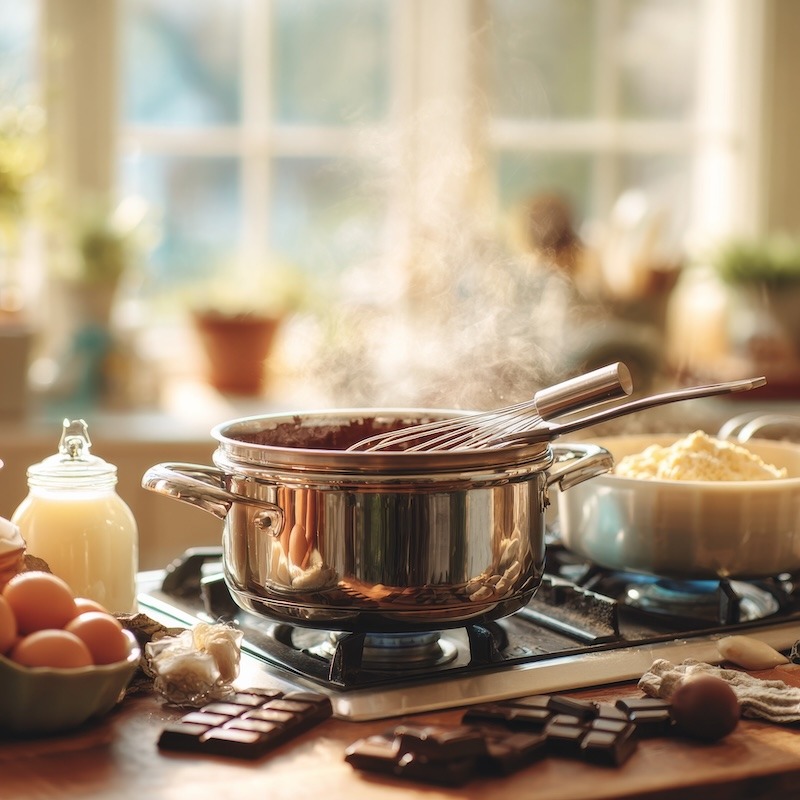

A double boiler might seem like a specialty tool, but it solves one of cooking’s biggest challenges: gentle, controlled heat. From melting chocolate to crafting delicate sauces and custards, this simple setup prevents scorching and curdling. Understanding how and when to use a double boiler gives you better texture, smoother results, and more confidence in the kitchen.
Why Double Boilers Belong in Any Kitchen
- Gentle, controlled heat: Prevents scorching and curdling when working with delicate foods like chocolate, custards, and sauces.
- Built-in insurance: Water creates a heat buffer, giving you more margin for error even if you step away for a moment.
- Better texture, better results: Smooth sauces, glossy chocolate, and stable emulsions are easier to achieve.
- Less stress for home cooks: Ideal for beginners and experienced cooks who want consistency without constant stirring.
- Versatile beyond desserts: Useful for melting, reheating, keeping foods warm, and gentle cooking tasks.
Master Gentle Cooking: Why Every Kitchen Benefits from a Double Boiler
Some kitchen tools shout for attention. The double boiler does not. It simply removes problems before they start.
When heat needs restraint rather than power, a double boiler creates a buffer that protects delicate ingredients from scorching, separating, or seizing. Instead of fighting hot spots and constant stirring, you get steady, forgiving heat that lets you focus on technique and timing. Chocolate melts smoothly. Custards stay silky. Sauces behave.
For home cooks, this isn’t about being fancy or old-fashioned. It’s about reducing risk and increasing consistency. A double boiler turns intimidating tasks into manageable ones, making it easier to cook with confidence and get reliable results, even when the recipe leaves little room for error.
What Is a Double Boiler
A double boiler is a two-part cooking setup designed to deliver gentle, indirect heat. It consists of a larger pot filled with simmering water and a smaller pot or heat-safe bowl that fits securely over the top. The steam from the water below warms the upper vessel without exposing it to direct heat.
This controlled environment makes a double boiler ideal for tasks that can fail quickly over high or uneven heat. Instead of cooking aggressively, ingredients are warmed gradually, reducing the risk of scorching, curdling, or separating. It’s a simple design, but one that quietly solves some of the most common problems home cooks face when working with delicate foods.
Available on Amazon
Where You Can Use a Double Boiler
| Use | Why It Works Best in a Double Boiler |
|---|---|
| Melting Chocolate | Prevents scorching or seizing that happens with direct heat. Creates smooth, glossy melted chocolate. |
| Making Custards (e.g., crème anglaise) | Keeps eggs from curdling by providing gentle, controlled heat. |
| Cooking Hollandaise or Béarnaise Sauce | Emulsifies slowly to avoid separating or scrambling the eggs. |
| Warming Milk or Cream | Avoids scalding and keeps dairy from forming a skin or burning. |
| Reheating Leftovers (like mashed potatoes) | Prevents drying out or burning. Especially good for creamy dishes. |
| Melting Wax (for candymaking or DIY beauty projects) | Controls temperature for safety and even melting. |
| Making Lemon Curd | Prevents eggs from cooking too fast and ensures a smooth, silky texture. |
| Preparing Sabayon or Zabaglione | Requires constant whisking over gentle heat to get light and airy texture without curdling. |
| Cooking Egg-Based Sauces | Keeps sauces like cheese sauce or pudding smooth and lump-free. |
| Tempering Chocolate | Maintains precise temperature control during the tempering process. |
Do You Need a Double Boiler
Not necessarily. You don’t have to buy a specialized pan set—any deep, wide pot with a heat-safe glass or metal bowl that fits snugly on top can work. The key is maximizing contact between the bowl and the pan to ensure even, gentle heat.
In fact, a homemade setup often works better than store-bought inserts. Some purchased sets have rims that trap food or make whisking awkward—the very motion you’ll usually need in a double boiler. Using a whisk-friendly bowl gives you better control and flexibility.
Even if you don’t use it every day, a double boiler shines when melting chocolate, making custards, or preparing delicate sauces. By heating ingredients indirectly via steam, it prevents scorching, curdling, or separating, giving you consistent, reliable results every time.
Professional cooks often call this setup a Bain-Marie—a term for a water bath that works similarly, either on the stove or in the oven, for gently cooking delicate foods like custards or cheesecakes.

My Version of a Double Boiler Using a Pasta Pot & Stainless Mixing Bowl
How to Use a Double Boiler
Please note that cooking times and temperatures may vary depending on the specific ingredients and recipe used. It is essential to follow the instructions in your recipe and monitor the ingredients as they cook or melt to prevent overheating or burning.
To use a double boiler, you will need to follow these steps:
| Step | Action | Why It’s Important |
|---|---|---|
| 1 | Fill the bottom pot with water | Fill the large pot with 1–2 inches of water—enough to touch (but not submerge) the bottom of the top pot or bowl. |
| 2 | Place the top pot or bowl securely | Set the smaller pot or heatproof bowl on top. It should rest snugly and not touch the water. |
| 3 | Bring water to a boil, then reduce to a simmer | Heat the bottom pot over medium-high until boiling, then reduce to low or medium-low to maintain a simmer. |
| 4 | Add ingredients to the top pot | Place chocolate, custard mix, egg yolks, etc., into the top pot or bowl. |
| 5 | Stir or whisk as needed | Stir or whisk ingredients gently and continuously, depending on the recipe. |
| 6 | Remove from heat safely | Use oven mitts to lift the top pot or bowl carefully. Watch for steam! |
| 7 | Use the finished product | Fold into a recipe, pour over a dish, or let cool and store. |
Double Boiler FAQ
General Questions
Q: What is a double boiler?
A: A double boiler is a two-part cooking setup: a pot of simmering water below and a bowl or smaller pot on top. Heat transfers indirectly via steam, making it ideal for delicate foods like chocolate, custards, and sauces.
Q: Why should I use a double boiler?
A: It provides gentle, even heat, reducing the risk of scorching, curdling, or separating ingredients. It’s perfect for achieving smooth, consistent results with chocolate, custards, sauces, and other delicate recipes.
Q: Is a double boiler necessary in every kitchen?
A: Not always. It’s most useful for tasks that require controlled, indirect heat, such as melting chocolate, making custards, or delicate sauces. For everyday cooking like boiling pasta or cooking vegetables, a regular pot works fine.
DIY and Equipment Questions
Q: Can I make a double boiler at home?
A: Yes! Use a deep pot with 1–2 inches of water and a heat-safe metal or glass bowl that fits snugly on top without touching the water. This DIY setup often works better than store-bought inserts.
Q: Do I need a special double boiler pan set?
A: No. Store-bought sets can have rims that trap food or make whisking difficult. Any wide, deep pot and a whisk-friendly bowl will do the job.
Q: What is a Bain-Marie?
A: A Bain-Marie is a water bath, similar to a double boiler. It can be used on the stove or in the oven for gentle, indirect cooking of custards, cheesecakes, and terrines.
Usage Questions
Q: Can I use a double boiler to melt chocolate?
A: Absolutely. A double boiler gently melts chocolate without scorching or separating it, giving a smooth, glossy finish ideal for desserts and confections.
Q: Can I cook oatmeal in a double boiler?
A: Yes, especially steel-cut oats or whole groats. It provides slow, even heat for creamy, non-sticky oatmeal. Quick or instant oats don’t need a double boiler and cook faster in a regular pot.
Q: How do I prevent water from touching my ingredients?
A: Make sure the top bowl sits snugly above the simmering water. The steam—not the water—cooks your food. If water touches the bowl, it can change texture or dilute the mixture.
Q: How do I control the heat?
A: Keep water at a gentle simmer, not a rolling boil. Move the top bowl off the heat if the water starts boiling too vigorously. This ensures smooth, even cooking.
Maintenance and Safety
Q: Can I use a double boiler for small or large batches?
A: It works best for small to medium batches. For large quantities, a regular pot or pan may be faster and more practical.
Q: How do I clean a double boiler?
A: Wash the top bowl normally. For the bottom pot, avoid letting food or water sit too long; rinse and wash with warm, soapy water. Stainless steel or heat-safe glass is easiest to clean.
Q: Are there foods I shouldn’t cook in a double boiler?
A: Avoid foods that don’t need gentle heat or that you want to cook quickly, such as pasta, rice, or large batches of vegetables.
DIY Double Boiler: No Special Pan Needed
- Grab a pot: Use any deep, wide pan that can hold 1–2 inches of simmering water.
- Pick a heat-safe bowl: Glass or metal works best; it should sit snugly on top of the pot without touching the water.
- Maximize contact: The more of the bowl that’s inside the pot, the gentler and more even the heat transfer.
- Whisk-friendly matters: Skip store-bought inserts with rims that trap food—metal or glass bowls make whisking easy.
- Control the heat: Simmer water gently; move off heat if it boils too vigorously.
With this simple setup, you get all the benefits of a double boiler—melting chocolate, custards, sauces—without buying a specialty pan.
Can You Steam Oatmeal in a Double Boiler?
I was asked this in one of the comments below. Here’s what I say.
Yes, but it depends on the type of oats and the results you want.
When it makes sense:
- Steel-cut oats or whole groats: Slow, gentle heat prevents sticking and scorching.
- Creamy texture: Gradual cooking yields smooth, luscious oatmeal.
- Small batches: Gives precise stovetop control over consistency.
When it doesn’t:
- Quick or instant oats: Cook too fast to benefit from indirect heat.
- Large batches or speed needed: A regular pot or rice cooker is faster.
How to do it:
- Fill the bottom pot with 1–2 inches of water.
- Place oats, water (or milk), and a pinch of salt in the top pot.
- Bring water to a boil, reduce to a simmer, cover, and cook, stirring occasionally, until tender (~30–40 minutes for steel-cut oats).


21 Responses
Dear Reluctant Gourmet:
I’ve recently purchased a stainless steel double boiler (I’ve not yet used it). I intend to use it to steam vegetables as I understand the broccoli or whatever will cook at much lower temperatures, thus destroying fewer enzymes; in a word leaving the finished product in a more nourishing state. I understand a double boiler can also be used to steam oatmeal but will take longer. I don’t know if any of this is true but would appreciate your opinion and any advise you might offer. Thank you.
If you are intending to put the steamer basket in the top pot it would take a lot of extra energy to get the water in the top pot to boil, and if you do get to that point it would likely take a long time to actually steam the veggies. Better to just steam them normally in a pot, you can use the bottom pot with a steamer basket, but keep the heat a bit lower so the water doesn’t boil as rapidly. I’ve never tried “double steaming” water from bottom to top pot but I just have a feeling it might not work so well.
Hi Monte, see my answer above in the post.
Spot on with this write-up, I absolutely feel this amazing site needs a lot more attention.
I’ll probably be back again to read more, thanks for the information!
can you cook in a double boiler pots if you separate them on the stove…silly question but new to cooking in double broiler.
Great question Sheila. I guess it depends on the bottom of the double boiler insert pot. I don’t own a double boiler but make my own with a larger and smaller pots when I need one. Some double boiler insert pots have rounded bottoms which would make it a little tricky to use as a stand-alone pan but if both have flat bottoms, I don’t see why it wouldn’t work.
Any other thoughts on this out there?
why get a double boiler for that, just use to regular pots or pans. I have an old double boiler from my grandparents. I actually do use the pots individually to heat soup or other things. That is just using them as if they were normal pots and not using them for the express purpose of the double boiler. I think the name double boiler is a bit of a misnomer because only the bottom pot actually boils. You don’t want the ingredients in the top pot to boil, and I’m not even sure if that is possible but I’ve never tried it either. Thanks 🙂
Hey Jeff, I agree if you don’t have a double boiler, use a couple of pots and/or pans that you do have. I’ll have to look up the history of the name, “double boiler” since you are right, you only want the lower pot to come to a boil. Thanks for sharing.
No you generally should not. Why not? Because you will notuce most inserts are not made of 18/10 thick stainless steel. They are often thin single ply metal or aluminum and if placed onto a direct heat source will warp and be ruined. They are made of thin materials so they can heat up just enough for the delicate sauces in them to heat easily with just the steam from below them. Its called Double because you have two pots. Boiler because the water in the bottom pan boils
when I bought my pots and pans set the large pot came with an attachment which I assumed was for steaming vegetables and melting chocolate just as a double boiler does. I haven’t used it yet but tonight I was planning to boil potatoes and stem frozen vegetables in the top attachment. Is this wrong and if so what is this for?
Hi Beverly, not sure without seeing the attachment. Does it have holes in the bottom?
I just bought a recipe book with many cream-based soups listed, and the author encourages use of a double boiler to heat the cream in a safe manner so it is unlikely to scorch.
My problem is that I would like to make at least six generous portions of soup, so I do not understand why finding a ready-made 4-quart double boiler is nearly an impossibility! It seems like home-use ones are no more than three quarts — and the commercial ones are HUGE – like sixteen quarts. Do you have ANY advice for me, please??
An older friend of mine just purchased a double boiler and is looking for additional recipes. Is there a cookbook I could get for him that he might enjoy working his way through?
Hi Sandra, There aren’t many cookbooks dedicated solely to double boiler cooking, but several well-regarded cookbooks include recipes or sections where double boilers are either recommended or essential—especially for custards, confections, sauces, and delicate egg or chocolate work. Here are some worth checking out:The Professional Pastry Chef, Essentials of Classic Italian Cooking, Bouchon Bakery, The Art of French Pastry to name a few.
re. using a lower pot of the double boiler: As the r-gourmet said, no problem. At least, if you wash out the lower pot.
I say this because, I have the lower pot of my Mom’s and it has hard water spots which would prevent any quality cooking. It, by the way, is made of Aluminum (now try not to use that metal). I have recently been trying to find a non-aluminum double boiler — to no avail. I did a few years ago — it was large, nice and the set included a pan with holes for steaming veggie etc. But now no replacements, w/o ordering an expensive set on line. So surprised at the scarcity of this cooking staple (former staple).
My son bought me a stainless steel double boiler/steamer set by Tramontina. I think it was a little pricey ($50ish range?) but it is very nice. I use it at least twice a week, and I’m trying something new in it today: no-peel hard boiled eggs. Good luck finding one for yourself.
I have a glass double boiler that has a wire that you put on the electric burner and then place your double boiler on it. It was originally my mom and now I use it. My neighbor just bought a glass double boiler and hers does not have the wire that mine does can it still be used on an electric stove or should we make some type of wire to put on the burner and then set the double boiler on
My Aunt, who would be in her late 80’s today, used a double boiler when making her (spaghetti sauce.)It smelled so good and the smell was like no other, making your mouth water. I could not believe it when I tasted it! I was just a young girl and thought, how did she make it so good! Later,after I got married, I asked her how she made it but only found out that she used fresh tomatoes.
While she cooked it, when I was a young girl,I watched her poor more water in the bottom. Then she stirred it and left the cover off the whole time. Now I wish I would have found out more details because I crave that special tomato sauce. I’m thinking of looking up her daughters to find out. I’d love to find out more details. It’s to die for! I’ve had some good sauces, but I tell you, nothing like this one!
A logical way to forestall the boiling of water time…measure the amount of water you need and microwave it until it boils put it in the bottom pan of the double boiler, put the top pan over it, load your food and put on the lid.
since the water is already boiled, you can use a gently flame to keep the water boiling gently and you will have steamed meats, vegetables and whatever else you like.
It works as I just did it today, 25, August 2020.
Hi Floy, thanks for this very interesting tip. I’ll give it a try.
BTW, There was an old double boiler company called Savory. (They also made slow cookers). Their specialty let the steam come up and then drip back down thru tiny holes into the top pot. I learned this when trying to get a Double Boiler recipe book & read it. One might find this pot on Etsy etc. (which is where I found this book). I am right now steaming up my vegetable crumbles in my DB. I did add some water to those crumbles. My electric steamer via Crock-Pot is the main steamer I have. It is 6qt & no I did not need that much for steaming them. I will learn more after they are done.
Replying to my crumbles vegges — they came out okay. The bag wanted me to microwave them. But this DB style was fine for me