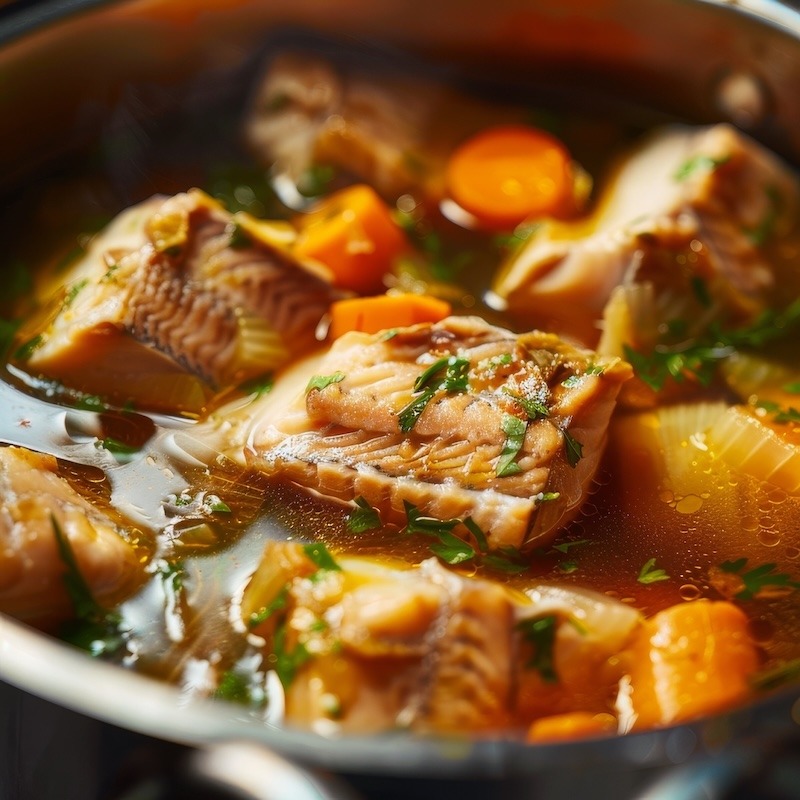
Toss the boxed broth—real flavor starts with homemade fish stock. It’s the secret weapon behind knockout soups, stews, and seafood sauces that actually taste like the ocean (in a good way). Fast, fragrant, and surprisingly easy, this is the base that’ll make your next seafood dish seriously sing.
Why This Fish Stock Recipe Is Essential
- Elevates Seafood Dishes: Adds a deep, natural flavor to risottos, soups, and sauces, making every seafood dish taste professionally crafted.
- Fresh and Clean Taste: Unlike store-bought options, homemade fish stock has a delicate, non-fishy flavor tailored to your dishes.
- Utilizes Whole Fish: Reduces waste by transforming fish heads and bones into a rich, flavorful base.
- Quick and Easy: Ready in about 30 minutes—half the time of traditional chicken or beef stocks.
- Customizable: Add aromatics and herbs to suit your taste, creating a unique, signature stock for your kitchen.
A Step-by-Step Guide to Making Delicious Fish Stock
Unlock the secret to restaurant-quality seafood with this easy homemade fish stock recipe. Using fresh fish bones, aromatics, and herbs, you create a rich, flavorful base that elevates soups, risottos, and sauces.
Unlike store-bought versions, this fish stock delivers a clean, delicate taste that enhances every dish. Save money, reduce waste, and transform leftover fish parts into a culinary powerhouse.
Ready in just 40 minutes, this recipe empowers home cooks to achieve professional flavors effortlessly. Follow our step-by-step guide and discover why mastering fish stock is essential for seafood lovers and ambitious cooks alike.
Fish Stock Recipe
Equipment
- Large Stock Pot
Ingredients
- 3 pounds fish bones fish heads or some combination of the two from non-oily, white fleshed fish like flounder, halibut, snapper, sea bass.
- 2 tablespoons olive oil
- 1 large yellow onion peeled and sliced thin
- 2 carrots thinly sliced
- 1 leek cleaned and sliced thin
- 3 stalks celery sliced thin
- 2 cloves garlic crushed
- ½ cup dry white wine
- 7 cups cold water
- 2 tablespoons black peppercorns
- 2 sprigs fresh thyme leaves and stems - roughly chopped
- 2 sprigs fresh parsley leaves and stems - roughly chopped
- 2 bay leaves dried
- salt & pepper to taste
Instructions
Clean the Fish Bones
- Place the fish bones and/or heads in a large bowl and cover with cold water.
- Add 2 tablespoons of salt and stir to dissolve.
- Soak for 30 minutes, then drain and rinse thoroughly under cold water to remove blood and impurities.
Saute Aromatics
- Heat a large stock pot over medium heat and add olive oil.
- Once hot, add onion, carrots, leek, celery, and garlic.
- Sauté until the vegetables soften, about 3 minutes.
Depaze with Wine
- Pour in the white wine to deglaze the pan.
- Let it cook down for 2–3 minutes until slightly reduced.
Add Fish Bones & Water
- Add the cleaned fish bones and/or heads to the pot.
- Pour in enough cold water to cover, about 7 cups.
Add Herbs and Spices
- Add black peppercorns, thyme, parsley, and bay leaves.
- Bring the stock to a gentle boil over medium-high heat.
Skim the Foam
- As the stock heats, white foam will rise to the top. Use a spoon to skim off the foam.
- Once it reaches a boil, reduce heat to a gentle simmer.
Simmer the Stock
- Simmer uncovered for 20–30 minutes. Avoid overcooking to prevent bitterness.
Strain the Stock
- Remove from heat and let cool for 10 minutes.
- Strain through a fine-mesh strainer into another pot or large bowl.
- Taste and adjust seasoning with salt and pepper.
Store or Use
- If not using immediately, allow to cool another 10–15 minutes.
- Transfer to airtight containers and refrigerate for up to 3 days or freeze for up to 3 months.
Notes
Common Fish Stock Mistakes to Avoid
- Overcooking the Stock: Boiling too long makes it bitter; simmer gently for 20–30 minutes.
- Using Fatty Fish: Avoid oily fish like salmon or mackerel—they overpower the delicate flavor.
- Neglecting Aromatics: Skipping onions, celery, or herbs results in a flat, bland stock.
- Not Skimming Foam: Failing to remove scum creates cloudy stock with off-flavors.
- Adding Salt Early: Salt concentrates as the stock reduces; season at the end for balance.
Serving, Storage & Freezing Tips for Fish Stock
- Serving: Use immediately in soups, sauces, risottos, or seafood stews for maximum flavor.
- Refrigeration: Store in an airtight container for up to 3 days; keep chilled to preserve freshness.
- Freezing: Pour stock into ice cube trays or freezer-safe containers; freezes up to 3 months.
- Reheating: Gently warm on the stovetop; avoid boiling to maintain delicate flavor.
- Portioning: Freeze in small portions for easy use in individual recipes without waste.
Fish Stock FAQ
What is fish stock?
Fish stock is a flavorful liquid made by simmering fish bones, heads, and aromatics. It forms the base for soups, sauces, and seafood dishes.
Which fish are best for stock?
Use mild, white fish like cod, halibut, or sole. Avoid oily fish like salmon or mackerel, which can make the stock taste heavy or bitter.
Can I use leftover fish parts?
Yes! Heads, bones, and trimmings from fillets are perfect. Make sure they are fresh and properly cleaned.
How long should I cook fish stock?
Simmer gently for 20–30 minutes. Overcooking can make the stock bitter and cloudy.
Should I add salt while cooking?
No. Salt concentrates as the stock reduces. Season at the end to taste.
How do I store fish stock?
Refrigerate in an airtight container for up to 3 days, or freeze in portions for up to 3 months.
Can I use fish stock in non-seafood recipes?
Absolutely! It adds depth to risottos, sauces, and even vegetable soups.
Why is my fish stock cloudy?
Cloudiness usually comes from boiling too hard or not skimming foam. Simmer gently and skim frequently for clear stock.
Can I make fish stock ahead of time?
Yes. Make in advance, cool quickly, and refrigerate or freeze for later use. Defrost gently when needed.
How can I enhance the flavor of fish stock?
Use fresh aromatics like onions, celery, leeks, parsley, and thyme. Add a splash of white wine or lemon for brightness.
Is Seafood Stock the Same as Fish Stock?
Interesting question!
Fish stock is only made from the bones and body parts of fish, whereas seafood stock can be made with fish and shellfish.
When I make risotto that calls for it, I often use shrimp shells to make my simple stock by adding them to a pot of water and cooking the liquid down by half. This is more shrimp or shellfish stock, but it’s better than nothing.
Why Use Fish Stock?
Another great question. A well-made fish stock can greatly enhance the flavor of seafood dishes, like risotto and pasta, and it really reinforces the flavor of seafood sauces, like the Seafood Sauce for Pan Seared Fish Recipe.
A good fish stock also makes a great base for fish and seafood soups like New England or Manhattan Clam Chowder.


4 Responses
I made fish stock. It turned out very good. My remark is: if person leaves it to cool more then 1 hour, for example, for overnight, its necessary to take bay leaves out of stock, otherwise stock will get somewhat bitter. Thank you for sharing this method
If you’re filleting whole fish, what about including the skins along with bones and head ? And if yes on the skins, should they be scaled first or not ? Or would it matter either way ? I’m using fresh caught speckled trout. thanks
I do include the skin with out scaling them. I use a fine mesh strainer and it works great
Wow! Work at home dad, Really? You must be one heck of a researcher! I swear, You musta invented the cooking school program! You ar a sel-taught Chef! My Hat is off to you sir! I desire your cooking skills!