
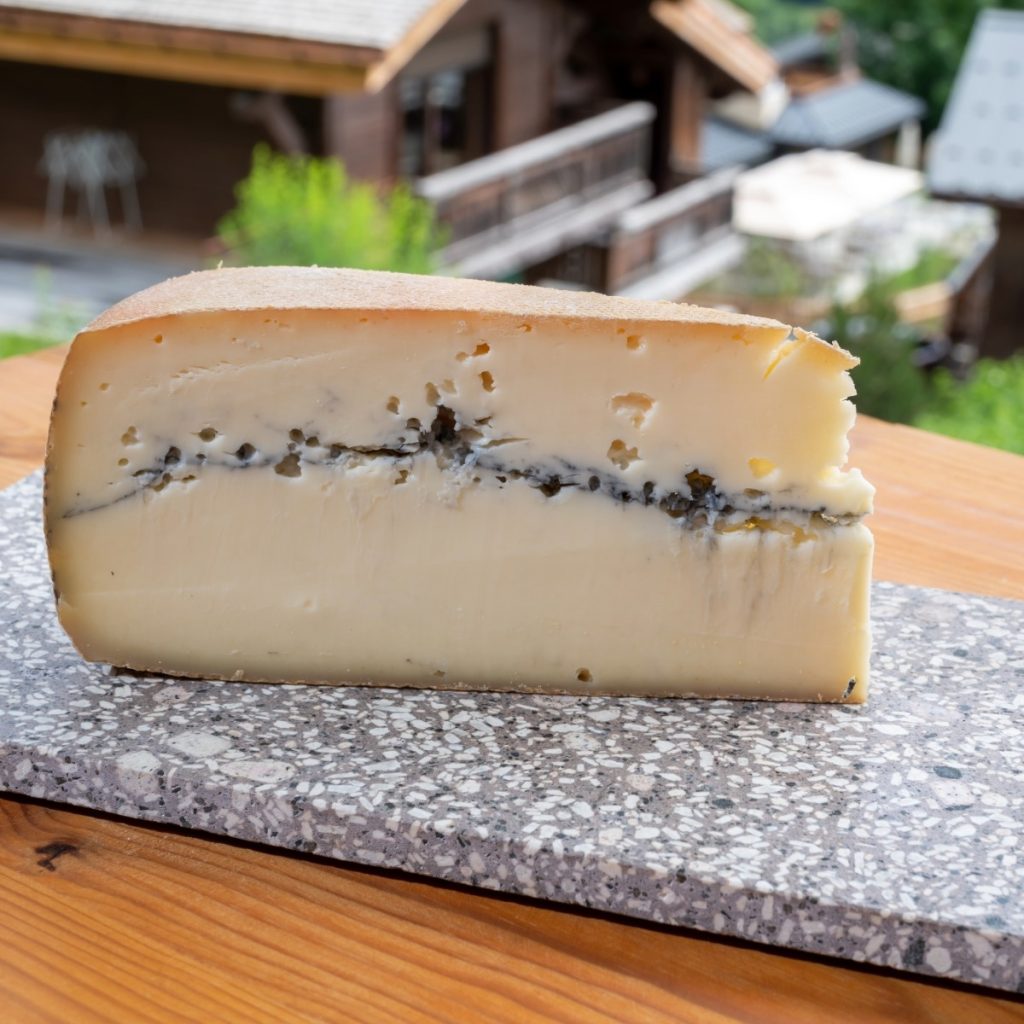

Morbier Cheese – (MORE-bee-yay) – a semi-soft cow’s milk cheese
You are going to love this cheese!
Morbier cheese stands out with its striking dark line across the middle. This creamy, semi-soft cheese comes from the Jura region of France. Traditionally, cheesemakers created it in two layers.
In the morning, they used curds from the first milking, covering them with a thin layer of ash. In the evening, they added curds from the second milking on top. The ash wasn’t just for looks—it protected the cheese until more curds were ready.
Today, that ash line is still there, though the process is modern. Morbier has a supple, springy texture and a mild, slightly nutty flavor. You might notice hints of fruit, hay, and even fresh milk. It melts beautifully, making it perfect for grilled cheese, fondue, or over roasted vegetables.
Serve Morbier at room temperature to bring out its full aroma and taste. Pair it with crusty bread and fresh fruit for a simple snack. Add a glass of white wine, like Chardonnay, or a light red, and you have an instant cheese board centerpiece.
Morbier’s unique look sparks curiosity, and its flavor keeps people coming back. Once you taste it, you’ll understand why it’s been loved in France for centuries. It’s rustic, yet elegant—just like the region it comes from.
Characteristics
Morbier cheese is celebrated for its distinctive characteristics, which make it a standout among French cheeses. Here are the key features that define Morbier:
| Characteristic | Morbier |
|---|---|
| Milk Source | Cow |
| Fat Content | ~45% fat in dry matter (approx.) |
| Texture | Semi-soft, supple, slightly springy |
| Aging | Typically 45–90 days (depends on producer) |
| Flavor | Mild, nutty, creamy with subtle fruity/hay notes |
| Aroma | Mild, milky and slightly earthy |
| Rind | Thin natural rind, sometimes brushed or lightly washed |
| Interior | Pale straw to light yellow with characteristic central black ash line |
| Size | Typically medium wheels (~6–9 kg / ~30 cm diameter for traditional wheels) |
| Versatility | Eats well on boards, melts nicely for cooking and fondue |
| Region | Jura, France |
| AOC / Protected Status | Appellation d'Origine Contrôlée (AOC) / Protected regional designation |
| Milk Treatment | Traditional AOC: raw milk; many modern versions use pasteurized milk |
| Coagulation Type | Rennet coagulation |
| Shape | Cylindrical wheel |
| Color (Interior / Rind) | Interior: pale straw to light yellow • Rind: ivory to tan |
| Shelf Life | Whole/aged wheels: months in aging; once cut: best within 2–3 weeks refrigerated |
| Serving Temperature | Bring to room temperature (18–20°C / 64–68°F) for best flavor |
| Traditional Season | Historically winter (cows kept indoors); now produced year-round |
| Diet of Cows | Pasture grass in summer; hay in winter (local Jura fodder traditions) |
| Culinary Uses | Cheese boards, grilled sandwiches, melting (fondue, gratins), paired with fruits and crusty bread |

Today’s Morbier
Modern Morbier cheese production has evolved from its traditional roots, but it still honors the historical methods that make it unique. Originally, Morbier was made from two batches of curd, with a layer of ash in the middle to protect the evening curd until the morning curd was added. Today, however, the production process has been standardized and typically involves a single batch of curd.
Despite this change, the distinctive ash line remains an essential feature of Morbier cheese. While the traditional practice used actual ash from the cheesemaker’s chimney, contemporary Morbier uses harmless, food-grade vegetable ash. This maintains the cheese’s characteristic appearance and pays homage to its origins. The ash is applied as a thin layer during the cheesemaking process before the curd is molded and pressed.
This method ensures consistency in production while preserving the visual and cultural heritage of Morbier. The cheese still undergoes a careful maturation process, during which the rind is washed and brushed, developing its signature sticky, orange-brown crust. The interior remains creamy, with the ash line running through the middle, and the flavor profile retains its complexity and balance.
The adherence to these traditional elements, even in a more modernized production context, underscores the importance of Morbier’s historical identity and its status as a cherished French cheese. This blend of tradition and innovation allows Morbier to continue delighting cheese lovers with its unique character and rich history.
About Morbier
Morbier cheese, originating from the Franche-Comté region of eastern France, is a semi-soft cow’s milk cheese renowned for its distinctive appearance and rich history. Characterized by a thin layer of edible ash running horizontally through its center, Morbier offers a visual and gastronomic delight. The ash, traditionally derived from soot collected from the cheesemaker’s chimney, originally served a practical purpose: to protect the evening curd from insects and dust until the morning curd was added. Today, this ash layer remains a nod to tradition, contributing to Morbier’s unique identity.
The cheese’s rind is typically washed and brushed to develop a sticky, orange-brown crust, which encapsulates the pale yellow interior. Morbier has a smooth and creamy texture, with small, irregular holes scattered throughout. Its flavor profile is complex yet balanced, combining nutty, tangy, and slightly sweet notes with a subtle aroma of fresh hay and damp earth. This flavor becomes more pronounced with aging, developing a stronger, more pungent character over time.
Morbier is produced under strict regulations that ensure its authenticity and quality, earning it the coveted Appellation d’Origine Contrôlée (AOC) status in 2000, which later transitioned to the European Union’s Protected Designation of Origin (PDO). These protections safeguard the traditional methods and regional specificity of Morbier production.
Enjoyed on its own, with crusty bread, or as a star ingredient in a variety of dishes, Morbier cheese showcases the rich heritage and artisanal craftsmanship of French cheesemaking, making it a beloved choice for cheese enthusiasts worldwide.
Morbier Cheese History
Morbier cheese has a rich history rooted in the traditions of the Jura mountains in the Franche-Comté region of France. Its origins date back to the 19th century when dairy farmers sought a way to utilize leftover curd from Comté cheese production. These farmers, often working in remote and mountainous areas, faced the challenge of preserving the curd from one milking to the next.
To address this, they developed a unique method: the curd from the evening milking was placed in a mold and covered with a thin layer of ash. This ash, collected from their chimneys, served a dual purpose: protecting the curd from insects and dust and maintaining its moisture. The following morning, the curd from the next milking was added on top of the ash layer, and the cheese was pressed and left to mature. This method not only ensured that no curd went to waste but also gave Morbier its distinctive visual characteristic—the black line of ash running through its center.
Initially, Morbier was produced exclusively for local consumption, reflecting the self-sufficient and resourceful nature of the Jura farming communities. However, as the cheese gained recognition for its unique flavor and texture, it began to be produced and enjoyed more widely.
In 2000, Morbier achieved Appellation d’Origine Contrôlée (AOC) status, which later became the European Union’s Protected Designation of Origin (PDO). This status ensures that Morbier is made according to traditional methods and within the designated geographical area, preserving its historical and cultural significance.
Today, Morbier stands as a testament to the ingenuity of Jura’s cheesemakers and their ability to create something unique and lasting from simple, local ingredients.
Reader’s Question
I received an email from a reader asking, I was doing some research on Morbier and came across your site. Specifically, the following:
“Today they make it from a single batch of milk “
I find this hard to believe. Every time I eat Morbier, I notice that one layer is smooth and mild and the other layer is more bitter. I am trying to find out which layer is which. Eric
I asked my friend Cheese Monster Jack what he thought about Eric’s situation and here is what he said,
” I have never noticed a difference in flavors between layers. There is a slight difference in butterfat content between morning and evening milk. In Lombardy, there is the saying ” Tired cattle give good milk”. Saying that, the cream still rises to the top. So if the cheese is not flipped occasionally in its storage yes, one side will taste richer than the other.”


6 Responses
I love cheese, but bought this one eager to try it. Unfortunately it smelt like dead fish. I tossed this in the trash thinking it has gone bad. I have yet to find what the aromatic property of the cheese is?
D, you are not the only one who doesn’t care for its aromatic properties. I have not heard dead fish before, but once site I checked out said, “The inside of a food waste bin. It’s that rotting vegetable matter thing. Sweetness on the edge of decay.” “Baby poo. Seriously, it’s just like baby poo.” Another site said, “Morbier does have a moderate stink factor but stay away from any that smell rancid or like ammonia.” I love morbier but I also like most stinky cheeses. I guess it is an acquired taste or smell in this case but don’t give up on it.
I adore Morbier. When my local cheese shop stocks it, you’d better get some quickly, because it sells! The first time I tried, the aroma was just a bit intimidating, but hey, that’s cheese for you.
On the other hand, there’s Limburger. Once I bought some Limburger at my local grocery. I thought, “Hey, if I like Morbier, how bad could Limburger be?” Well, as it turns out, very bad indeed. True baby poo bad. And yet it’s popular enough to be found in any Kroger store. How am I supposed to appreciate Limburger? I understand that one ancient uncle of mine used to enjoy Limburger cheese and sardine sandwiches. Was he just trying to prove his manliness?
Can Morbier be frozen?
Hi Karen, I would suggest you do not freeze Morbier or any delicate cheese for that matter. I suggest you vacuum seal cheese and store in your refrigerator. You will be surprised how long it can last if properly stored. I’ll work on an article about freezing cheeses with more details in the near future.
I have purchased this cheese three times. I. Found on first unwrapping and eating it was a very nice rich flavour and not too pungent. But once wrapped again and left for a couple of days seemed to decline in quality really quickly. My thought on this is to avoid wrapping in clingfilm or plastic. This seems to interfere with the flavour. In fact, any delicate cheese should be wrapped in baking paper first.
I am open to any further advice on this.