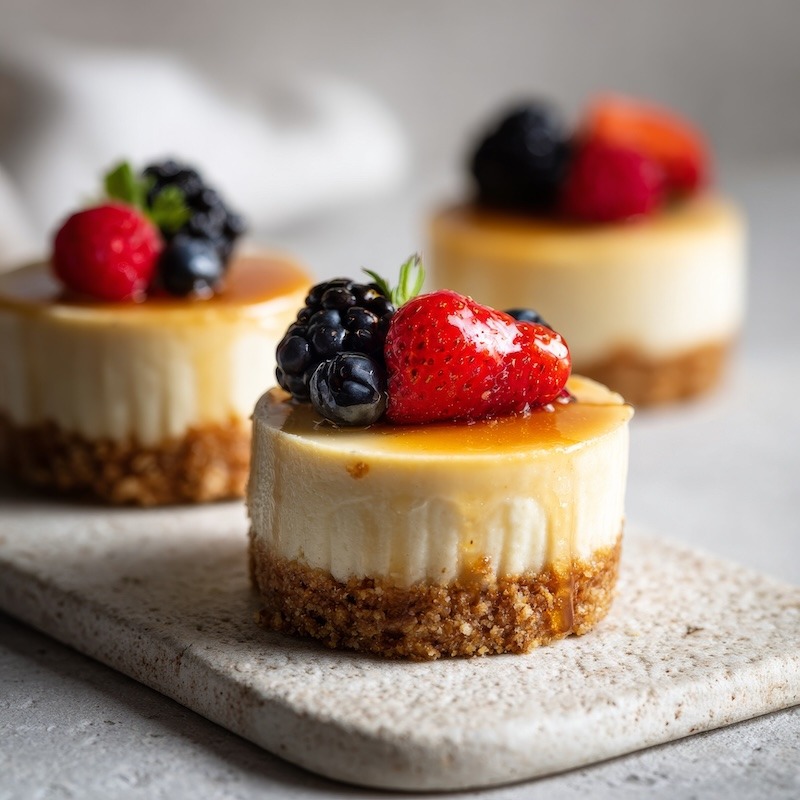
Mini cheesecakes that fit in your hand and your heart? Yes, please. These muffin-tin delights pack all the rich, creamy goodness of a classic cheesecake into bite-sized perfection. They’re easy to make, adorable to serve, and basically impossible to resist. Ready to become everyone’s favorite baker? 🧁
Mini Cheesecakes Recipe With No Water Bath (Smaller Size, Better Control)
Mini cheesecakes solve a big problem. They deliver everything people love about cheesecake without the wait, the slicing, or the stress.
This recipe keeps things simple. No water bath. No cracked tops. No mystery steps. You mix. You bake. You chill. You serve.
Each mini cheesecake bakes evenly. Each one releases cleanly. Each bite tastes rich, smooth, and balanced. The honey–citrus crust adds warmth. The creamy filling stays light but satisfying.
These are cheesecakes for real kitchens. You do not need special pans. You do not need fancy tools. A bowl, a whisk, and a standard muffin pan do the job.
Mini desserts feel intentional. They look polished on a plate. They work for parties, holidays, and quiet nights at home. Guests grab one and smile. Hosts relax.
This recipe also invites creativity. Add lemon for brightness. Swirl in berries. Melt the chocolate for depth. The base stays reliable, no matter the variation.
If cheesecake has ever felt intimidating, this version changes that. The steps are clear. The timing makes sense. The results reward you.
Once you make these, you will not go back to full-size cheesecake. These minis fit modern kitchens, modern schedules, and modern cravings.
Tips for Perfect Mini Cheesecakes at Home
Cold cream cheese resists blending and leaves lumps. Let it sit out until it presses easily with a finger.
Mix gently, not vigorously
Overmixing adds air, which can cause puffing and cracks. Smooth and calm beats fast and foamy.
Press the crust firmly
A tight crust holds together cleanly when unwrapped. Use a spoon or small glass to compress it evenly.
Pre-bake the crust every time
Even a short bake keeps the base crisp and prevents a soggy bottom once the filling is added.
Fill cups evenly
Consistent portions help all the cheesecakes bake at the same rate. An ice cream scoop works beautifully.
Look for a soft center, not a wobble
The edges should be set, while the center yields slightly when nudged. It will firm up as it chills.
Avoid browning the tops
Cheesecake should stay pale. Browning means the oven is too hot or the bake went too long.
Let them rest in the oven briefly
Cracking often comes from sudden temperature changes. A short rest with the door cracked keeps things calm.
Chill before removing liners
Warm cheesecake clings. Cold cheesecake releases cleanly and keeps sharp edges.
Add toppings at the last moment
Fresh fruit, whipped cream, and sauces stay vibrant and neat when added just before serving.
Use room-temperature eggs
Cold eggs don’t blend smoothly and can affect texture. Room temp equals silky batter.
Don’t rush the chill time
Two hours minimum gives structure and flavor. Overnight is even better if you have the patience.
Vanilla Bean Mini Cheesecakes with Honey–Citrus Crust
Equipment
- Muffin pan
Ingredients
Honey-Citrus Crust
- 1 cup graham cracker crumbs
- 2 tablespoons sugar
- zest of 1 small orange or lemon
- 4 tablespoons unsalted butter melted
- 1 tablespoon honey
Cheesecake Filling
- 12 ounces cream cheese softened
- ½ cup sugar
- 1 teaspoon vanilla bean paste or pure vanilla extract
- 1 large egg room temperature
- ¼ cup sour cream
- pinch of salt
Optional Toppings
- fresh berries
- fruit compote
- melted chocolate
- whipped cream
Instructions
Prepare the Pan
- Preheat your oven to 325°F (165°C).
- Line a standard muffin pan with paper liners. This makes removal easy and keeps the edges tidy.
Make the Crust
- In a bowl, combine the graham cracker crumbs, sugar, citrus zest, melted butter, and honey. Stir until the mixture resembles damp sand.
- Spoon 1½ tablespoons of crust mixture into each liner. Press firmly using the back of a spoon or a small glass to form an even base.
- Bake the crusts for 5 minutes, then remove from the oven and let cool slightly.
Mix the Cheesecake Filling
- In a medium bowl, beat the softened cream cheese until smooth and lump-free. Add the sugar and mix until creamy.
- Blend in the vanilla, egg, sour cream, and salt. Mix gently just until combined. Avoid over-mixing to keep the texture silky, not airy.
Fill the Cups
- Divide the cheesecake batter evenly among the muffin cups, filling each about ¾ full. Tap the pan lightly on the counter to release any air bubbles.
Bake
- Bake for 18–20 minutes, until the centers look set but still slightly soft when gently nudged. The tops should remain pale, not browned.
- Turn off the oven, crack the door open, and let the cheesecakes rest inside for 10 minutes. This helps prevent cracking.
Cook and Chill
- Remove the pan from the oven and let the cheesecakes cool completely at room temperature. Transfer to the refrigerator and chill for at least 2 hours before serving.
Finish and Serve
- Just before serving, add your favorite toppings. Fresh berries keep things bright, while chocolate or whipped cream adds indulgence.
Notes
Pro Tips for Perfect Minis
- Room-temperature ingredients ensure a smooth filling
- Gentle mixing keeps the texture dense and creamy
- For clean edges, peel off liners only after chilling
Mini Cheesecakes FAQ
1. Can I make mini cheesecakes without a water bath?
Yes! This recipe is designed to bake perfectly without a water bath. The small size and gentle oven temperature help prevent cracking. A short rest in the oven after baking also keeps the tops smooth.
2. How do I prevent cracks on mini cheesecakes?
Use room-temperature ingredients, mix gently, and avoid overbaking. Let cheesecakes rest in the oven with the door slightly open for 10 minutes before cooling. Chilling fully before serving also helps prevent cracks.
3. Can I use different crusts?
Absolutely! Graham crackers are classic, but you can use digestive biscuits, vanilla wafers, or even Oreo crumbs. Just mix with melted butter and press firmly into muffin cups.
4. Can I make these cheesecakes in advance?
Yes. Mini cheesecakes can be made a day ahead and stored in the refrigerator. They keep well for 2–3 days and can also be frozen for up to a month.
5. Can I add flavors or toppings?
Yes! Lemon, chocolate, pumpkin, or berry swirls work beautifully. Top with fresh fruit, chocolate drizzle, caramel, or whipped cream just before serving.
6. Can I make a no-bake version?
Yes. Fold whipped cream into the filling, skip baking, and chill for at least 4 hours. No-bake mini cheesecakes are creamy, smooth, and simple.
7. What size muffin pan should I use?
A standard 12-cup muffin pan works best. You can also make smaller bite-size versions in mini muffin pans; just adjust baking time slightly.
Mini Cheesecakes Variations
| Version | Additional Ingredients | Where to Add in the Recipe |
|---|---|---|
| Chocolate Mini Cheesecakes |
¼ cup melted dark chocolate 1 tablespoon cocoa powder |
Stir into the cheesecake filling after adding the vanilla, before the egg. |
| Lemon Mini Cheesecakes |
Zest of 1 lemon 2 tablespoons fresh lemon juice |
Add zest with the sugar; mix lemon juice in after the sour cream. |
| Pumpkin Spice Mini Cheesecakes |
½ cup pumpkin purée 1 teaspoon pumpkin spice |
Blend pumpkin purée and spice into the filling after the cream cheese and sugar. |
| Berry Swirl Mini Cheesecakes | ½ cup berry compote or jam | Spoon a small amount on top of the filled batter and swirl gently with a toothpick before baking. |
| No-Bake Mini Cheesecakes |
1 cup heavy cream, whipped 1 tablespoon powdered sugar |
Fold whipped cream into the finished filling; skip baking and chill for 4 hours. |
Cheesecake History
Cheesecake is one of those desserts that has been around so long, it’s basically prehistoric—but with a surprisingly traceable evolution. Here’s the story:
Origins
The earliest records of something resembling cheesecake date back to ancient Greece, around 2300 BCE. The Greek physician Aegimus is said to have written a book on the art of making cheesecakes.
These early cheesecakes were simple: cheese, flour, and honey, baked on flat stones. They were served to athletes during the first Olympic Games as a source of energy.
Roman Era
When the Romans conquered Greece, they adopted the cheesecake recipe and refined it. They added eggs and baked it more like the modern version. Roman cheesecakes were often served at weddings and festivals. Latin writers like Cato the Elder described baked cheese desserts called libum, which were often offered to the gods.
Medieval Europe
During the Middle Ages, cheesecake spread across Europe. In England and France, it evolved into more custardy versions with richer dairy, sometimes including cream. In Italy, ricotta became a common base, while in Germany and Austria, quark cheese was used.
Modern Cheesecake
The cheesecake we know today, especially the creamy New York style, emerged in the late 19th–early 20th century, when cream cheese was invented in 1872 by William Lawrence in New York. This innovation allowed for smooth, rich, and stable cheesecake filling.
So, in short: the ancient Greeks started it, the Romans refined it, Europe diversified it, and modern cheesecake is a 19th-century American innovation.


One Response
Waouh. Very interesting